Discounted renewable power

img_0596We’ve recently moved to Bulb as our electricity and gas supplier. Bulb is a new company founded by Hayden and Amit providing 100% renewable electricity and 10% renewable gas and, for us, was the cheapest provider of the same.

Bill logo

Bulb logo

Bulb are currently offering a £50 discount to new customers via this link, so there’s even more incentive to go renewable.

They also have 9.8 out of 10 on TrustPilot, a UK call centre, and are a Living Wage employer.

Please follow and like Greening Me:
Pin Share

Energy Unit Costs

We’ve just switched energy suppliers at the end of a fixed rate term.  Unit costs are as follows:

Oct 2015
- Sep 2016
Oct 2016
- Dec 2016
Jan 2017
- date
Day-time electricity 11.71 p/kWh11.90 p/kWh11.48 p/kWh
Night-time electricity 7.57 p/kWh6.86 p/kWh7.87 p/kWh
PV electricity (when available if metered)4.85 - 4.91 p/kWh4.91 p/kWh4.91 p/kWh
Any-time gas3.01 p/kWh2.43 p/kWh2.35 p/kWh
PV electricity (when available if deemed like mine)0.00 p/kWh0.00 p/kWh0.00 p/kWh

In both cases electricity is on so-called ‘green’ plans where the supplier sources electricity to match my consumption from renewable sources such as wind turbines, solar farms, or hydroelectric.

I’ve included my export rates in the table as for some technologies this will make a difference to the cost-effectiveness of that technology.  My electricity company chooses to deem my export so it pays me assuming that 50% of my generated electricity is exported, rather than metering and paying for my actual export.  That results in the cost to me of using my own solar being zero, whereas if export was metered then using my own solar would cost me the export payment.  Thus for me it’s economically attractive to use excess solar to make hot water rather than using gas thus saving the cost of gas but, for someone with metered export, the lost export payment would outweigh the saving in gas.

Since the table rows are ranked by unit price (higher priced fuels are at the top) then another way to look at this is that it’s financially attractive to replace a fuel higher in the table with one lower in the table, but disadvantageous to replace a fuel lower in the table with one above.

Please follow and like Greening Me:
Pin Share

Annual Energy costs

I was reading a newspaper article earlier which highlighted a 3 bed semi with annual energy consumption costs of £500.  Our net energy consumption costs for my early ’70s 4 bed detached in 2015/6 was £400.  That includes charging my electric car.

img_0591

The house has:

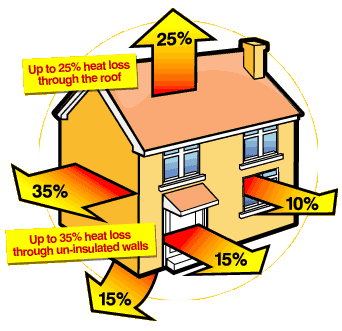
  • A-rated gas boiler (Dec 2015),
  • A-rated double glazing throughout (prior owner),
  • C-rated hot water cylinder with bottom-entry immersion heater and all accessible hot pipes insulated (Dec 2015),
  • 7 day timer (prior owner) with Thermostatic Radiator Valves (TRVs)  throughout (except hall and 2 towel rails – Dec 2015),
  • Standard cavity fill and 4″ loft insulation (prior owner, now nearer 10″ but Oct 2016 installation outside 2015/6 data window),
  • Almost 100% low energy bulbs (mostly Sep 2015),
  • 4kWp solar panels (Sep 2015) with energy management system (Sep 2015) with remote monitoring (Mar 2016) directing surplus PV to car charger (Apr 2016) and/or hot water cylinder (Dec 2015), and
  • Economy 7 electricity (Oct 2015).

I spent £1,000 on gas and electric in 2015/6 which was partially offset by £600 revenue from my solar PV giving net costs of £400. Given that some of the above were introduced during the year, a full year’s use should reduce consumption further.


Please follow and like Greening Me:
Pin Share

Solar PV Installation – 1 year on

solar-panel-ikea

We’ve now had our solar panels for 1 year, so it would seem time for an update on how things are going. Our 4kW SSE-facing system has an expected annual generation of 3,668 kWh. However after a year in service I’m pleased to see that we’ve generated 4,056 kWh – 10% more than expected.

The financial returns on a solar PV system are a combination of 2 things: (i) payments from your chosen electricity company for energy generated and exported to the grid and (ii) savings from not having to buy so much power as you use that which you’ve generated instead.

When it comes to payments from the electricity company, my electricity company (like many) chooses not to go to the expense of installing an export meter and instead assumes that half of the power which I generate is exported to the grid. The total annual revenue for the first 12 months of operation, including both generation and export (assumed to be 50% of generation) is £629.62.

Then there’s the question of how much electricity I save. I’ve only had monitoring of usage since March (approximately 6 months) but in that time I’ve used 41% of the generated electricity to replace bought electricity. 41% of 4,056 kWh is 1,663 kWh. What is less clear, is what the unit saving for this energy is. Some of this is daytime usage like standby loads, the fridge, cooker and other daytime loads at 11.7 p/kWh; but some would otherwise be night time loads like dishwasher, washing machine, or car charging at 7.57 p/kWh. I don’t measure the split so I’m simply going to assume an average unit rate = (11.7 + 7.57)/2 p/kWh = 9.6 p/kWh. 1,663 kWh @ 9.6 p/kWh = £159.65.

Finally, there’s the question of how much gas I save by making hot water from solar PV electricity rather than gas. Since March I’ve used 813 kWh or 27% of the generated power for water heating, so for a whole year 27% of 4,056 kWh is 1,095 kWh. The immerSUN itself records 995 kWh used for water heating since December. I’m also going to assume that not all the heat from the gas boiler would have ended up in the tank as hot water since some is lost via the boiler flue to the outside world, and some is lost via the pipes to the inside of the house – so let’s say 80% efficient on gas. 1,095 kWh @ 3.01 p/kWh @ 80% efficient = £41.20.

The combined total of my revenue and savings for a whole year would have been £830.46 – a 13.6% return on the investment or payback in 7.3 years.

The tariff scheme will have provided me with about 20 years of income by the time it closes, so the investment in the panels, as well as helping me reduce my carbon footprint, will have generated 12+ years of profit having paid for itself during the 8th year.

Please follow and like Greening Me:
Pin Share

Charging ahead

image
Today I read a number of comments elsewhere from those who didn’t think it was possible to run an electric vehicle in the UK with a ‘significant’ degree of solar charging. I’m not sure how they come to that conclusion when some of us are doing it.

Now clearly the vehicle needs to be home, sometimes, and there’s a limit to how much can be generated; but it certainly works for me. I average around 20 miles per day, which is about 6 kWh of electricity; but my average daily generation is 11 kWh. That’s clearly seasonal, so I doubt that I can solar charge through the depths of winter – November to January I don’t generate 6 kWh on average let alone have 6 kWh available for EV charging.

It needs a certain mindset. I think most EV users try to get a full charge when they charge but many go for several days between charges. With solar charging I try to ensure that I have enough charge on board for the day ahead (potentially charging a little overnight to achieve this when necessary), but on a sunny day with the car at home I can get a full charge during the day. I only try to get a full charge by the start of a day on imported electricity when I know I’m going on a relatively lengthy trip, otherwise I deliberately don’t aim for a full charge to leave space for solar input if available. Whenever the car is at home it’s plugged in ready for when the sun shines. Typically I’ll leave the weekend with the vehicle almost fully charged (1 full day of sunshine can get a full charge), that will drift a bit during the week, possibly benefitting from a day at home during the week if I have meetings in London, then by the weekend it’s almost empty.

Top-ups during the week (at least during the summer) are often before I leave for work in the overlap where I have some solar (but not enough to run the charger) but am also in the Economy 7 window.

Overall I think that I have a good claim that most of the electricity for charging comes from my own solar during the course of a year.

Please follow and like Greening Me:
Pin Share

Results with variable charging

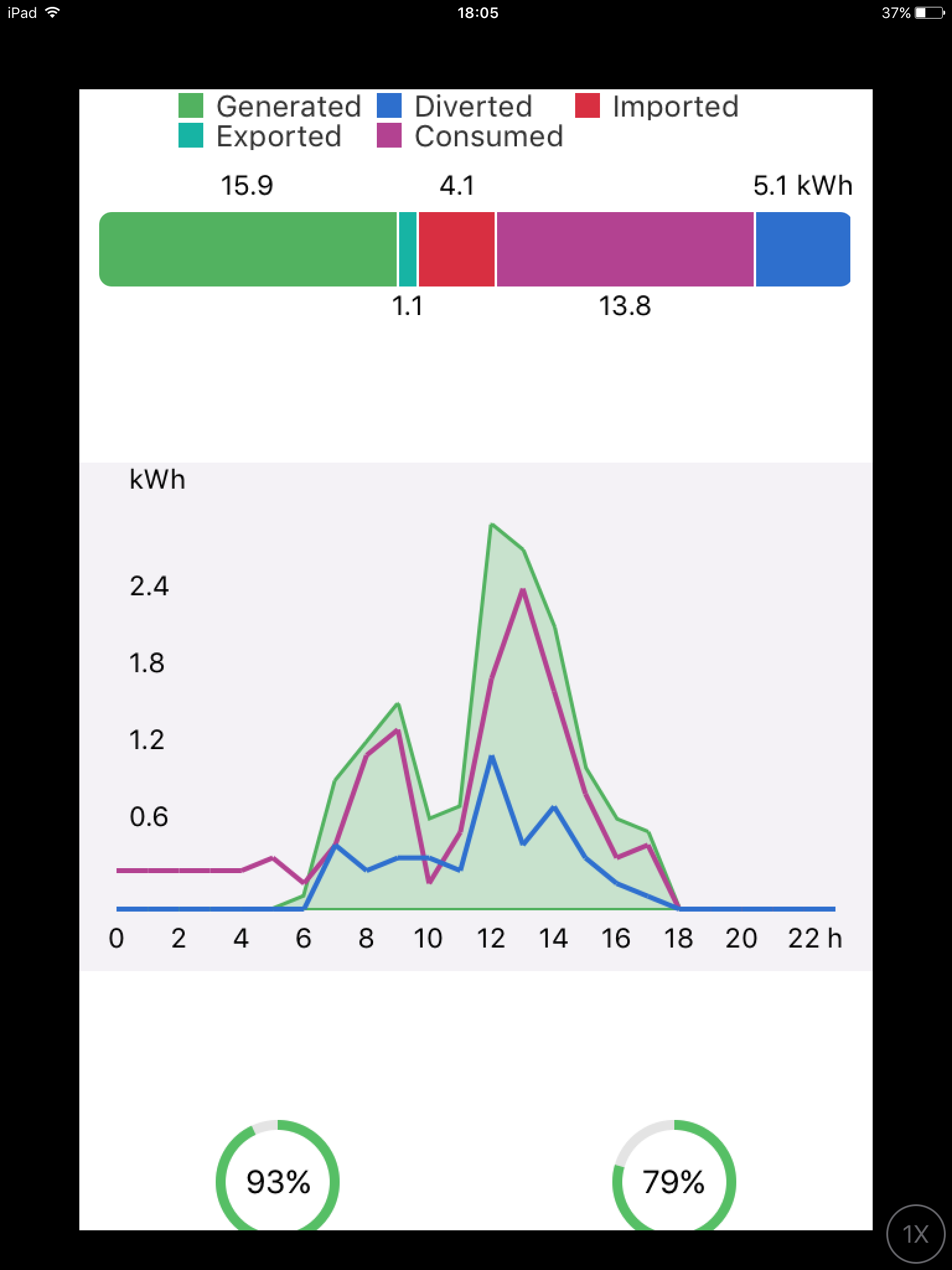
Today is my first day with the car plugged in all day since I completed the variable charging which directs the car to charge at 0, 6, 10, or 16 Amps depending on availability from my solar panels.

imageThe green area shows the electricity generated by the solar panels. The purple line shows the demand for electricity – the larger changes are the car charger switching on and up/down. I myself witnessed it switching between 6 and 10 Amps while working in the garage. The blue line shows the second priority – electricity being used for water heating. The water heating control is more dynamic and adjustable in finer increments so it mops up what the car charger cannot.

In total:

Electricity Sources Electricity Uses
4.1 kWh of electricity was bought/imported. 13.8 kWh of electricity was used by the house (including car charging)
15.9 kWh of electricity was generated. 5.1 kWh of electricity was diverted for water heating.
1.1 kWh of electricity was exported to the grid.
20.0 kWh of electricity total input. 20.0 kWh of electricity total output.
93% of electricity generated used productively. 79% of electricity used self-generated.
Please follow and like Greening Me:
Pin Share

Why I didn’t buy .. a battery

This week for the first time a salesman ventured into my home to sell me a battery for my solar PV system. His company were not the first to discuss it on the phone, or make an appointment, but this guy actually turned up which is a first.

The principal of such a battery is straightforward – there will (often) be times when you generate more electricity than you can use immediately, so why not store it for later use?
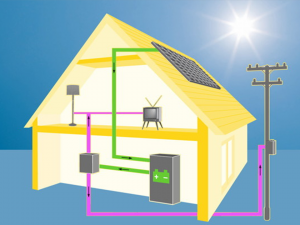
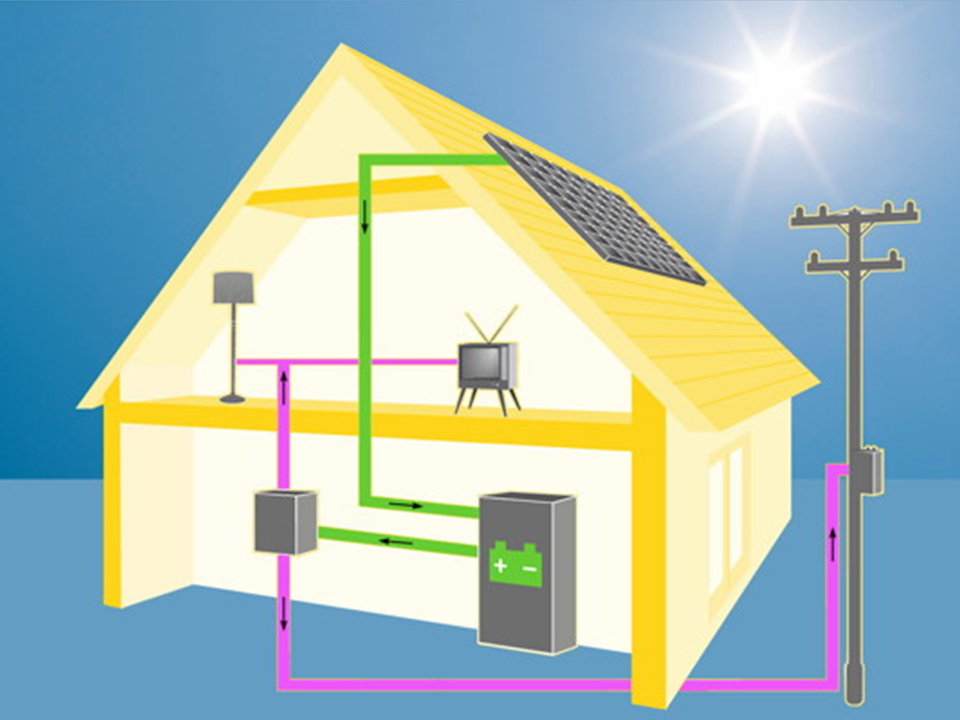
imageFirstly, let’s think about the architecture of the system that was being presented. This system puts a battery and a charge controller on the DC side of the inverter i.e. between the panels and the inverter. This reduces consumption on the generation meter when you charge the battery, but registers on the meter when the battery is discharged – not in itself a problem just a difference.

This architecture creates a system in which the battery can only charge in daylight and only discharge in darkness but to my way of thinking that’s less efficient than it could be. Firstly during my day there are often load peaks that go beyond what the panels can cover. Events like boiling a kettle, or the heating periods on the dishwasher or washing machine often push electricity demand beyond the immediate panel output, and you you might hope that the battery would cover these peaks and then recharge later – but no this system cannot discharge the battery during daylight so you’d end up buying electricity for these peaks. No discharge in daylight also means that activities like cooking in summer evenings on our electric oven and hob would be on imported electricity (even though the battery has sufficient energy) because it’s still daylight. Finally my Economy 7 meter tells me that I regularly don’t use as much as 4kWh overnight but to get pay back you want to empty and refill the battery as many times as possible.

Of course I could shift electrical load to the nighttime to empty the battery, but that’s contrary to trying to move load to the daytime to maximise use of PV directly. Which is better? Hard for the user to tell since no tools are provided to tell the user how much energy is in the battery, or any history of usage. By contrast my immerSUN produces detailed graphs of usage to show you what it’s achieving on my behalf. If this can be done with one device, why not also with a battery costing 20 times more?

How can I make sure the battery is empty in the morning when my normal night time usage would only be 1-2 kWh? Well you might consider running a heater to warm up a critical room or rooms at the start of the day (once you’ve got the equipment the energy is free of course), or in my case I might want to top up the electric car, is there a switched output or other mechanism to signal when the battery is exhausted and switch off such a device? No there isn’t.

So it can be hard to ensure that the battery is empty. What about filling it, how easy is that? Remember that the proposed battery has 4 kWh working capacity and sits on the DC cables between the panels and the inverter. Well, my 4 kW PV system like many is actually 2 x 2 kW systems feeding dual input inverter. That means that only half my panels would feed the battery so to fill the battery I’d need to generate at least 8 kWh in a day (and not use much of that during the day as immediate usage is prioritised over battery charging). My average daily generation between November and February is well below 8 kWh so there are many days in which the battery wouldn’t be charged fully (and may be not at all).

Then there’s the kicker – the price. If I look at a battery with 5,000 cycles life (that’s over 10 years although the brochure also quotes 10 years as the life) where each cycle is 4 kWh (which it will only be when new) that’s a lifetime throughput of 20,000 kWh. Electricity at today’s money is about 12 p/kWh so those 20,000 kWh are worth roughly £2,400 in savings. And the price of the unit? More than double that.

I did a detailed analysis including my actual ability to charge the battery based on real daily generation and usage, declining battery capacity with age and use (down to 80% of original capacity after 5,000 cycles), and energy price inflation; and concluded that energy price inflation would need to be around 30% annually each year just to get my money back over 10 years – without actually generating a return on the investment. While I do expect energy prices to rise faster than inflation in the long term I think 30% annually is unrealistic.

In the next few years I expect battery prices to fall as more cells are made for other purposes like electric cars, and also as used cells/batteries become available from electric cars at the end of their lives. I also expect revenue opportunities to arise through grid stabilisation and support where some access to the domestic battery is made available to support the local network.

However a battery on the DC side of the invertor which only charges in daylight and only discharges in darkness will be of little use to support the grid. I think a battery needs to be on the AC side of the inventor to flexibly interact with the house and grid based on charging to eliminate export and discharging to eliminate import in microcycles (unless the grid overrides that).

So I do expect to get battery storage eventually – just not now, not at this price, and not this solution.

Please follow and like Greening Me:

Pin Share

Not so new wheels

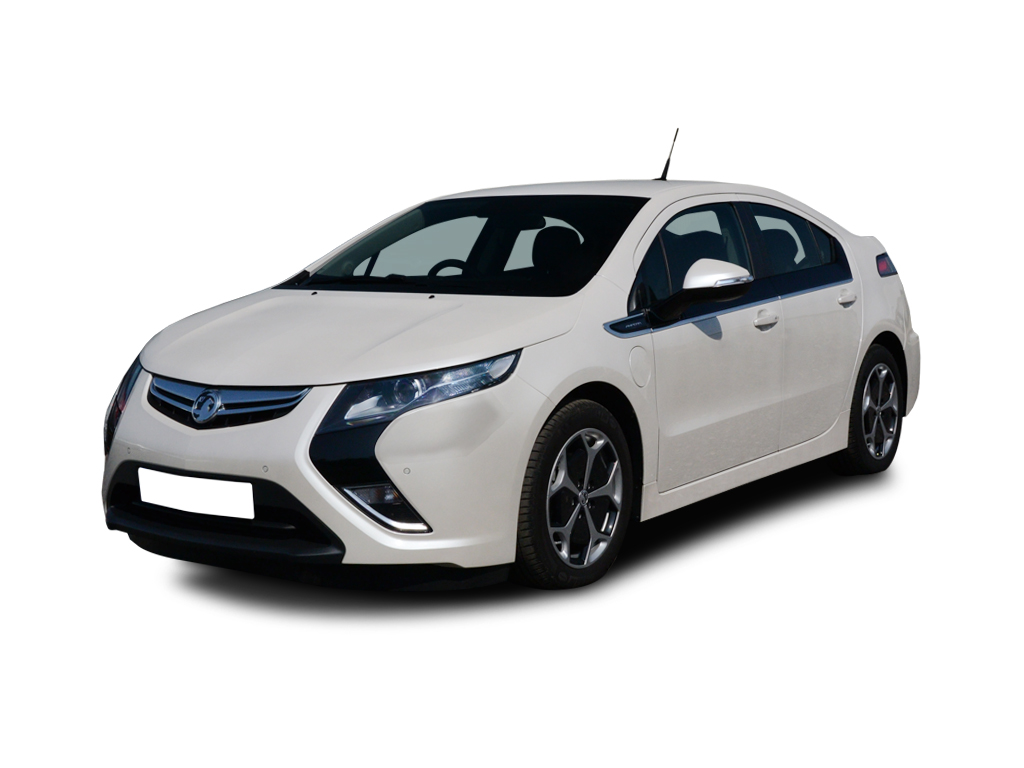
AmperaI’m now 2 years into my Ampera ownership. My average fuel economy is 207 mpg reflecting the fact that most of my 8,000 miles per year is driven on electricity, indeed I think that I last filled up with petrol in January and it’s now August. I have about 60 miles worth of petrol left which may see me into September.

Most of my mileage is of course powered by electricity. Domestic electricity is much cheaper than petrol anyway, but much of my charging (particularly in summer) is free because I use my own solar power. Obviously the solar system itself is not free, but the money it earns from generating electricity and supplying it to the grid does not depend on what I actually supply to the grid or how much I use. It makes no difference to my revenue how much of the electricity that I generate goes into the grid, making my energy costs when using my own electricity zero.

My charger control project describes the development of a solar-powered charger which, in its current form, charges the car at a variable rate depending on output from my solar panels. When the output of the panels is too small to charge the car, or there’s a small surplus while charging the car, or the car is not plugged in, then any surplus solar power is diverted to the immersion heater; but when the car is plugged in then its charging is prioritised over hot water. That priority reflects the relative costs: night time electricity that I would otherwise use for car charging costs me around 8 p/kWh, while gas that I would otherwise use for water heating costs me only around 3 p/kWh. Thus every kilowatt of solar electricity used to charge the car that otherwise would have been exported saves me 8 pence; while every kilowatt used for car charging that otherwise would have been used for water heating saves me around 5 pence. Those savings might sound small but I’d estimate that I’d otherwise buy around 2,500 kWh of electricity annually for charging the car (around £200 at night rates) for car charging – far cheaper than the equivalent distance in petrol but £200 is still money worth saving.

Please follow and like Greening Me:
Pin Share

For some time now my car charger has been linked to my solar panels so that it automatically turned on when enough surplus solar power was available enabling me to charge my electric car for free. This has helped me get up to an average of 70% of my generated electricity being used my me rather than export to the grid.

The latest refinement is intended to help me increase that beyond 70% while charging the car more quickly and reducing my use of bought electricity.

Variable rate charger

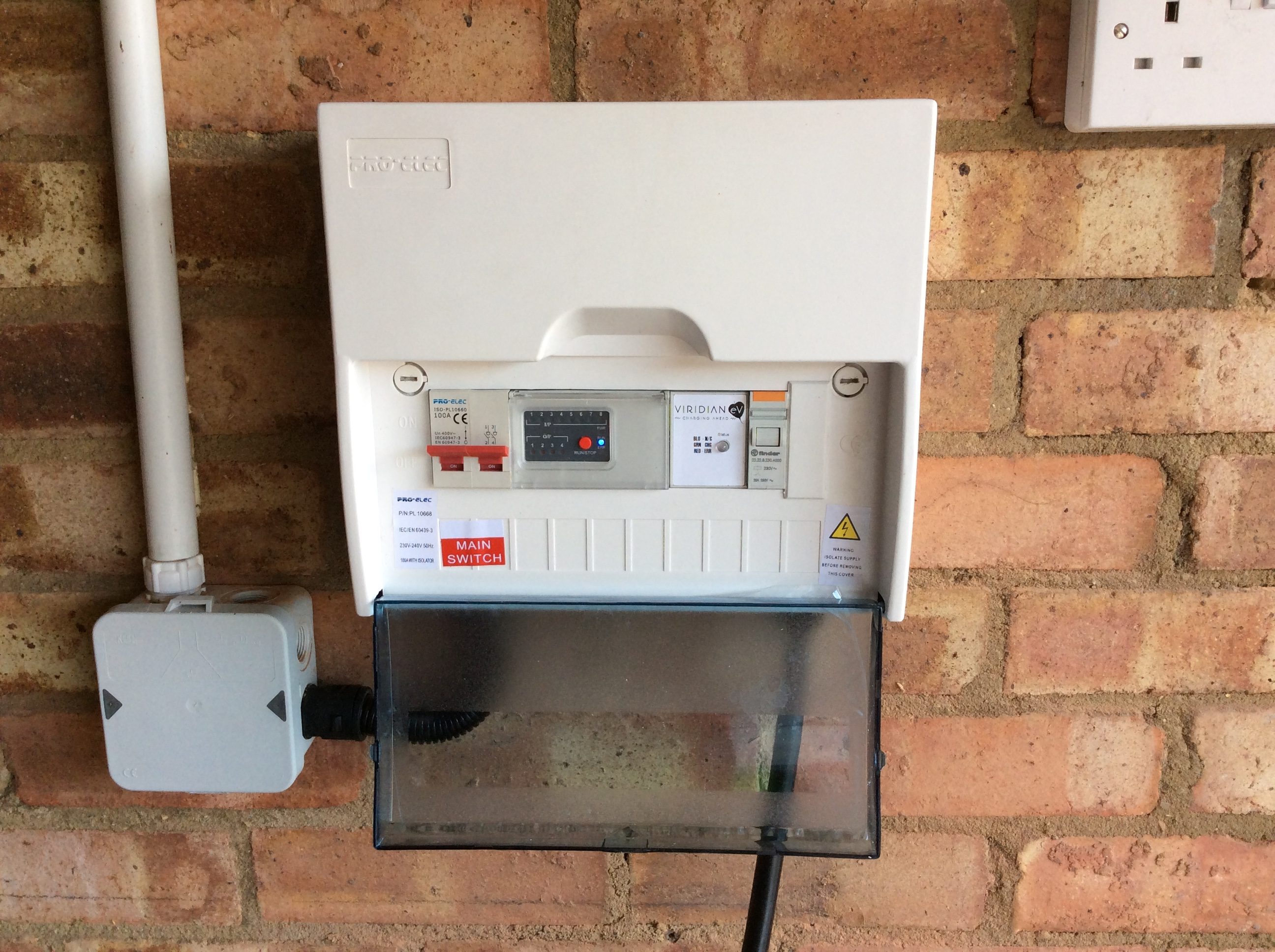
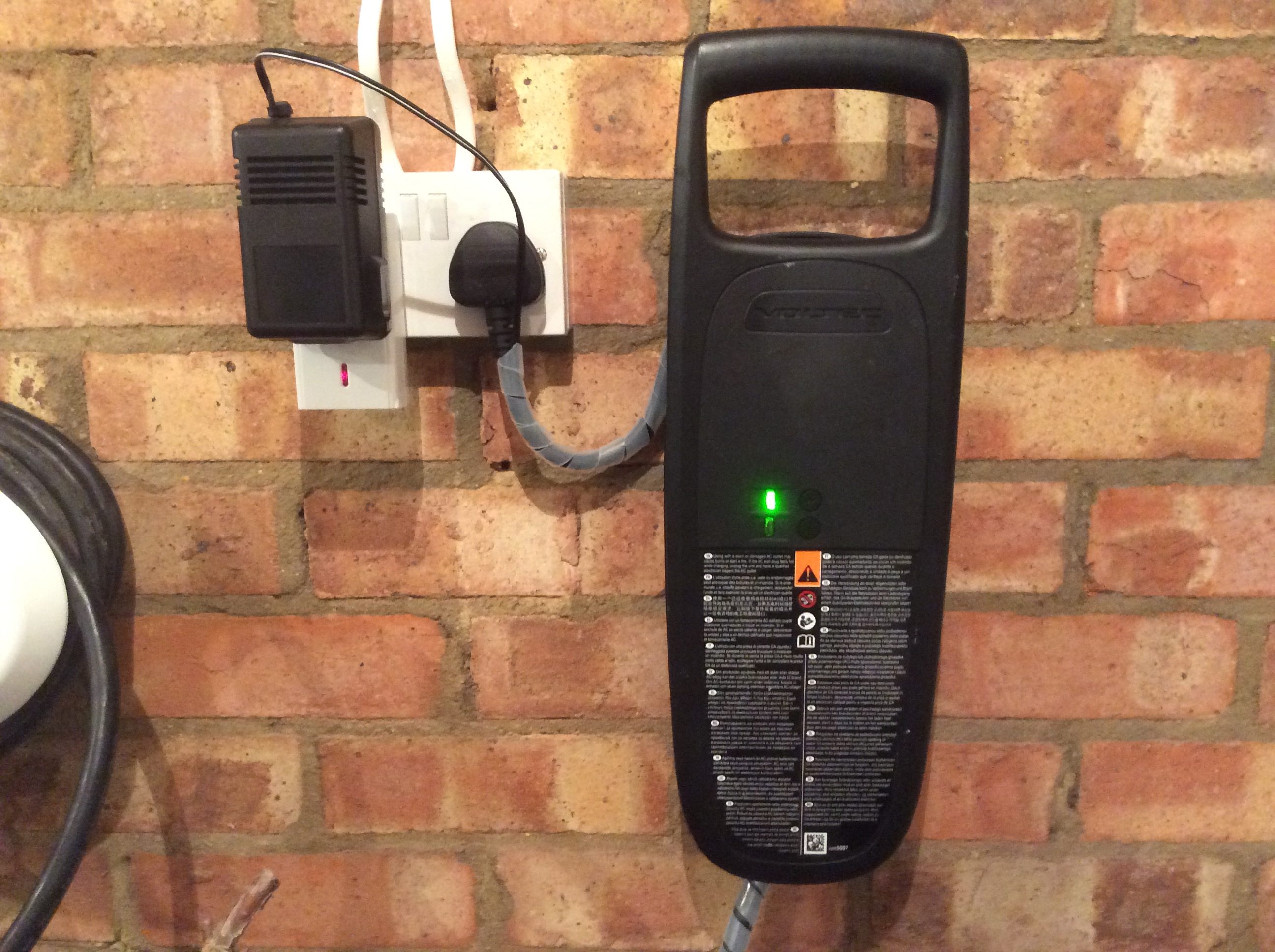
The new refinement allows the charger to switch between 0, 6, 10 and 16 Amps rather than simply off/on between 0 and 6 Amps. I needed a new case to get all the bits in, but the main technical difference is the use of a Programmable Logic Controller (PLC) to determine the desired charge rate.

The PLC is programmed from a laptop via a USB lead to create a programme in ladder logic which combines inputs (currently export threshold and contactor closed) with timers to switch on one of four different outputs corresponding to the four different charge currents (0, 6, 10 and 16 Amps).

Please follow and like Greening Me:
Pin Share

Solar car charging results

Well, with a bit of tinkering, my solar car charger is working with the charger turning on automatically when the output from the solar panels is sufficient, but I already have in mind a few improvements.

My issues include:

  • As it stands the system turns off as expected when household demand rises, such as when boiling a kettle, but it takes some time for charging to restart after the signal is sent, presumably down to some logic in the charging equipment. I’d prefer something a bit less dynamic in responding to short term demand changes, but that restarted sooner.
  • The signal from the ImmerSUN tends to turn off too quickly to my mind as, having turn on a relatively big load, it decides there isn’t enough capacity to run a big load. The logic effectively determines that there isn’t enough spare capacity to turn on the load a second time, turns off the load, and then decides that there is enough capacity. To my mind this just cycles the power unnecessarily and, with the delays in restarting already reported, also reduces total energy transfer.

Consequently I’m already working on improvements:

  1. Firstly I’m changing the protocol controller than coordinates the handshake with the vehicle. The new one should enable a more rapid restart after interruption without the uncertainties of the delays in the OEM controller. It will also provide an alternative mechanism to stop charging. Instead of suggesting to the vehicle that the cable is about to be disconnected, the new one allows more direct control of the current by resistor selection – or turning on/off via a contact across the resistor.
  2. Secondly I’m upgrading to variable current rather than a simple on/off at low current. The new protocol controller documents maximum current choice by resistor selection, but I think that I’ve worked out how to provide infinitely variable current via an analogue voltage. The car will respond to the infinitely variable signal by drawing the highest compatible current from 0, 6, 10 and 14 Amps.
  3. Thirdly I’m reconfiguring the output of the ImmerSUN to be more dynamic, but then..
  4. Finally I’m building a module to sit between the transmitter receiver and the protocol controller. The new module will set upper and lower current limits and set the ramp rate / time constant for the system response.

My intention is that the result of this is that in response to a jump in available power the controller will slowly ramp up the output to meet the availability and then slightly cycle the analogue output as the ImmerSUN output cycles on and off. The vehicle will respond by cycling between the currents immediately above and immediately below the available current. As an alternative strategy it can be configured to cycle just below the available power, and thus theoretically not import any power from the grid, at the expense of not fully using the available solar power.

Which ever strategy is used the more highly dynamic water heating will continue to mop up any available power between what the vehicle takes and what’s available from PV.

Please follow and like Greening Me:
Pin Share