My radio-controlled car charger

This weekend I finished my radio-controlled charger.

You may recall that I wanted to link the charging equipment for my electric car to my solar panels so that the car automatically charged when there was enough power from the panels. I’d previously settled on a simple on/off system charging at 6 Amps (the minimum setting) since analysis had suggested that this would maximise energy transfer as it seems to be more important to charge for the most hours than, for example, charge at more current for fewer hours.

It seemed that I would be easily able to configure my ImmerSUN to turn the charger on and off using its Relay: Export Threshold feature but I wanted to extend control to my car in the garage some way from the ImmerSUN without running a cable so far.
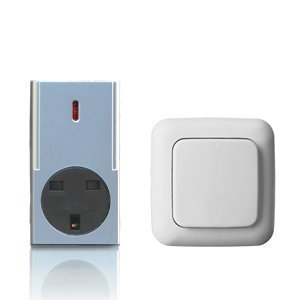
HomeEasyMy solution was to make use of a HomeEasy remote control light switch and remotely-controlled switched socket (available on Amazon for example). The switch is designed to send a radio signal up to 30 meters to operate the socket – a range of transmitters and receivers are available separately which can be paired by the user.

My remote controlWhen I dismantled the switch I found that in normal use the operation of the rocker operated two pushbuttons – one for on and one for off. I removed the pushbuttons from the circuit board and replaced them by cables to the relay outputs of the ImmerSUN. At the same time I reasoned that the button cell in the transmitter might not last very long in service, so instead I repurposed an old mobile phone charger as a power supply. The mobile phone charger was notionally 3.6 Volts, rather than the 3.0 Volts of the button cell, so I also added a simple voltage regulator chip and smoothing capacitor to ensure that I didn’t damage the transmitter from any over-voltage.

If you simply wanted to switch some mains powered device then you’d need to do little more than plug it into the remote-controlled socket to be able to switch it on and off automatically, but for my car charging equipment I wanted to do something a little more sophisticated. I had previously decided to interrupt a low voltage control signal so that the charging system turned on and off gracefully as if the user was engaged in the normal process of stopping and starting charger rather than forcibly turning the power off as if there was a power cut. To this end I fitted a small mains relay inside an empty case intended for a small power supply like those used for a mobile phone, so that when power is turned on or off volts-free relay contacts open and close. These contacts are wired in series with a push button that normally starts or stops charging so that, as far as the car and charger are concerned, the button release that indicates ready-to-charge doesn’t happen until there’s enough solar power available (by default).

I also have the option to manually enable charging or set up a schedule from the ImmerSUN for times when there either hasn’t been enough solar generation or the car isn’t home long enough to benefit from it.

All I need now is a reasonably sunny day when the car is at home to try it.

Please follow and like Greening Me:
Pin Share

Electric Vehicle Charging Opportunity from PV

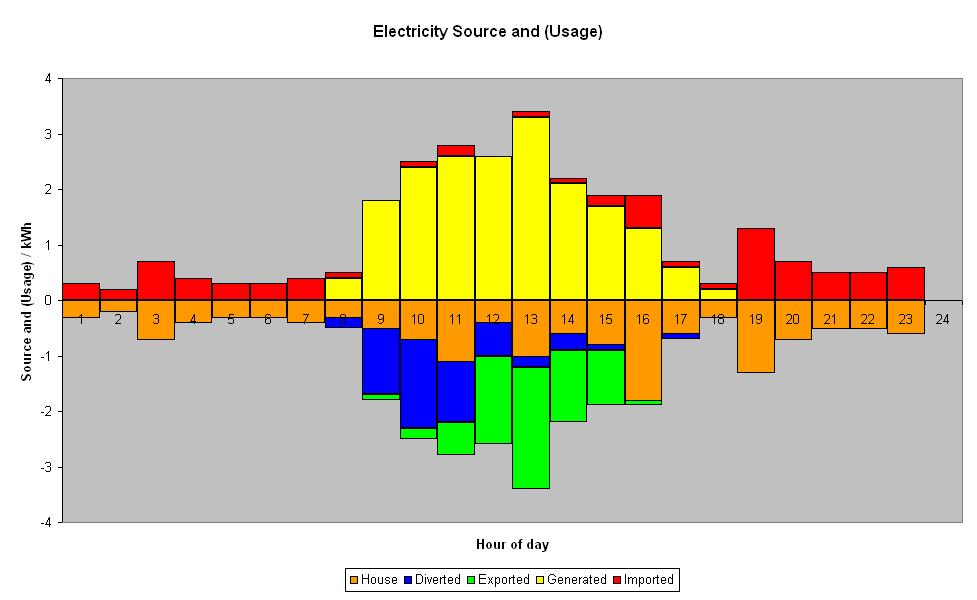
16-03-2016 no EVAs part of my electric car charger control project I thought I’d try to estimate the benefit of such a system. I’d already decided on resource grounds to do a simple on/off system. The car offers the choice of charging at 6 or 10 Amps. 10 Amps would of course charge more quickly, but would be available for fewer hours each day, so I thought I’d look at what might be possible with 6 Amp charging. My chosen date for analysis was March 16th a day on which we generated 19 kWh. The Immersun provided a hourly profile of consumption and generation through the day which included diversion of 5.4 kWh to generate hot water via the Immersun.

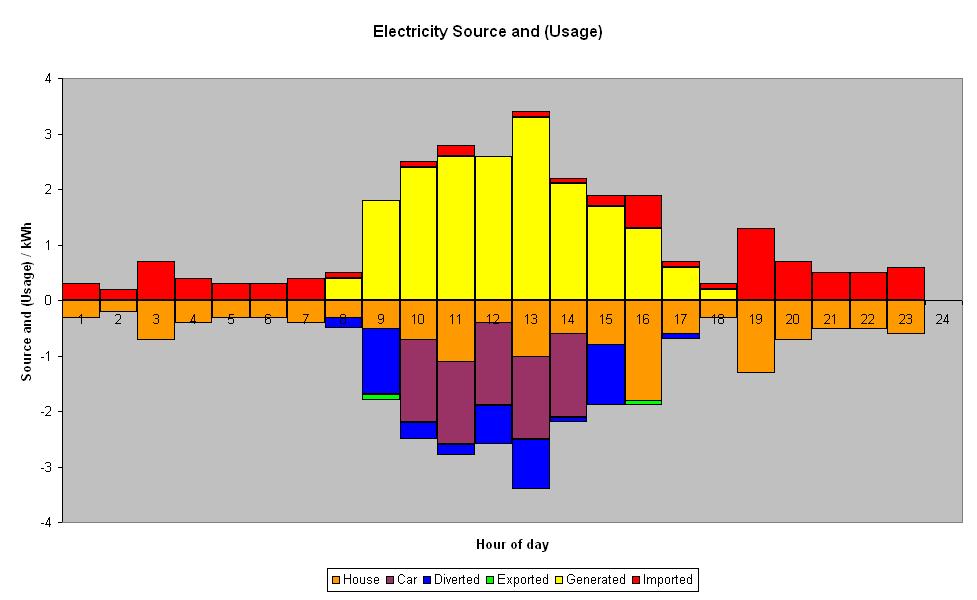
16-03-2016 6A EVFor my charging analysis I decided to prioritise EV charging over making hot water (an option within the Immersun) which would result in hot water being generated until 1.5 kW was available, once 1.5 kW was available then the car charger would be turned on, and then as the power increases beyond 1.5 kW then the water heater turns back on to absorb the excess.

The result of this strategy was that 7.5 kWh was diverted to charge the car, while water heating received 4.8 kWh (a slight reduction on the 5.4 kWh delivered for water heating without EV charging). Exported electricity dropped from from 7.5 kWh to 0.2 kWh – so effectively all the available power was used. 7.5 kWh is more than 50% of a full charge for the car and probably exceeds my average daily charge.

For the alternative 10 Amp charging strategy only a single hour could provide 2.3 kW for charging (a total of 2.3 kWh) so the 6 Amp charging strategy provided around three times the energy transfer to the vehicle.

If the project saved me the same 7.5 kWh from my night time electricity (my current pattern of car charging) that would save me 60 pence per day. Of course I wouldn’t save that every day – some days (particularly in winter) we don’t generate enough power and other days I’m at work (although it should work quite well at the weekend when I spend more of the day at home). Normally I start each day with the car fully charged, but on most days I return with a significant amount of unused charged (typically 50%), but I could choose a charging strategy where I don’t attempt to fully charge each day allowing some charging to be displaced from weekdays to the weekend. It thus gets quite hard to estimate an annual benefit.

Please follow and like Greening Me:
Pin Share

Making best use of energy

If I want to make best use of my solar PV (i.e. use as much of it as possible) then it seems logical to prioritise replacing my most expensive energy purchases. Examination of my bills suggests that my different sources of energy have the following costs:

  1. Day-time electricity: 12.31 p/kWh
  2. Night-time electricity: 8.02 p/kWh
  3. Any-time gas: 2.87 p/kWh
  4. Solar PV (when available): 0.00 p/kWh

In winter when little PV electric is available our normal practice is to shift as much electric load as possible to night time use saving 4.29 p/kWh by use of timers. Washing machine, dishwasher, and electric car charging all get shifted to Economy 7 by use of timers. The washing machine is the oldest and uses a external timer plug while both dishwasher and car have their own inbuilt timers allowing consumption to be delayed.

In summer the same approach can be used to shift these loads to daytime to make use of solar PV although if the weather is dull and cloudy there’s no guarantee that sufficient PV will be available risking consumption of bought daytime electricity.

My Immersun already minimises exported/surplus PV by running the immersion heater to mop up surplus electricity, although as gas is cheap the savings are smaller than might be achieved by avoiding a similar amount of night-time electricity consumption. In winter we minimise gas use for water heating, while still providing a gas safety net by displacing in both time and temperature. The Immersun naturally heats water in daylight hours only and generates hot water at 60C (not adjustable) as defined by the immersion heater thermostat. The gas is set to complement this being set by timer not to overlap Immersun hours and is set to 50C by the cylinder thermostat. The water temperature difference is not noticeable in practice especially as the showers are thermostatically regulated.

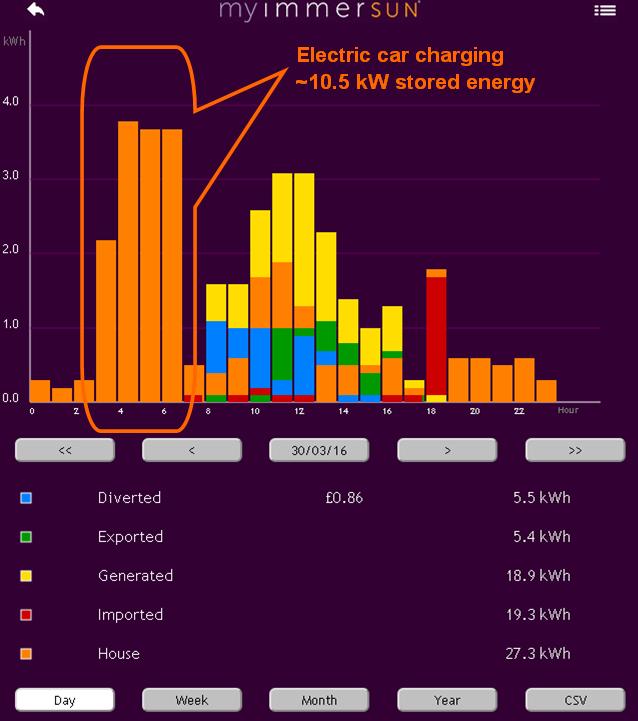
Car charging 1The device that consumes most electric power is undoubtedly my electric car. Its usable battery capacity is about 10.5 kWh and, with charging efficiencies, it can take up to 12 kW of mains electricity to charge (less in summer). The appeal of charging this on solar PV is high, although the cost of doing this if it inadvertently draws day-time electricity is also high (but still much cheaper than petrol or Diesel). It occurred to me that it would be good to use spare channels on the Immersun to control car charging as my largest consumer of my most expensive fuel. It has three channels – two variable power and one on/off – although it can be configured to produce three variable outputs using the on/off to switch between devices.

It seems to me that there are three alternatives for control:

  1. Proportional control.
  2. Stepped control.
  3. On/Off control.

Proportional control would be the most capable. The Immersun has the capability to provide proportional control to multiple resistive loads, and the Mode 3 communications standard to which virtually all electric cars adhere also provides for the charging equipment sending a proportional signal to the car via PWM, so there’s scope for a proportional system. However it seemed that the time to develop this was beyond what I have available, and in practice although the car would receive a proportional control signal it would normally respond in a stepped manner so there’s little to be gained by investing my time to develop a fully proportionate system..

Stepped control is easier to achieve. As it happens my car model is more steppy than some as I believe that it switches between 6, 10 or 15 Amps consumption only. 15 Amps is very close to the full 4 kW output of my panels and, given that there are always other loads in the house, then I don’t think it would ever use this setting, which leaves me with switching between 0, 6 and 10 Amps. Unfortunately of course you can’t switch between 3 states with an on/off signal that only has 2 states, so I’d still need to decode an analogue Immersun output or invest in a second Immersun to get another on/off output but I deemed the latter cost-prohibitive. Generating a variable current signal to the vehicle would also require some logic to reduce the pulse width on the PWM signal on demand – not impossible but still requiring some time to create.

That leaves me with on/off control at a fixed current. This is readily achieved from the Immersun which has a relay output that can be configured to operate when a certain solar power is available (such as 1.5 kW to drive a 6 Amp charger). I decided not simply to turn the whole charger on or off by switching the power as this would cause the mains contactors in the charger and the HV DC contactors in the vehicle to drop out under load which is bad for longevity. Instead I’ll interrupt a low voltage control signal within the charger to trigger stop and restart in a more controlled manner – effectively car and charging equipment will see the signal as the user wishing to disconnect the cable as you might if you wished to drive before charging was complete.

Finally I considered how to connect the Immersun to the charging equipment. Unfortunately the Immersun is in the airing cupboard upstairs (where it drivers the immersion heater) and the garage where the car charges is a separate building alongside the opposite side of house. Neither a second Immersun or a physical cable looked like an attractive prospect on cost grounds so I decided on radio control using around £20 of home automation parts and a total investment of around £40. More on this solution over the next few weeks.

Please follow and like Greening Me:
Pin Share

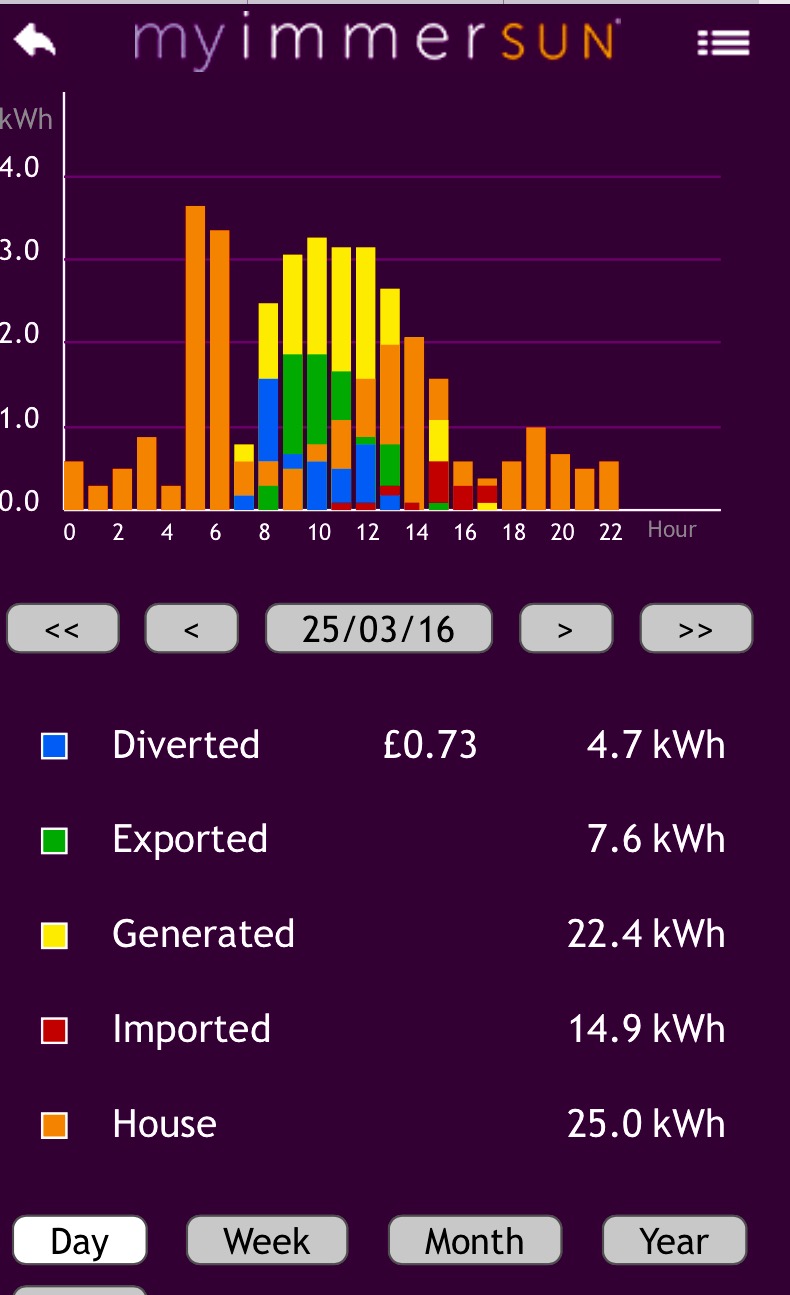
Solar panels can generate significant amounts of electricity for example on March 25th our 4kW panels generated 22.4 kWh over the course of the day as shown.
ImmerSUN 25-03-2016
This generation typically substantially exceeds the load being drawn by the house leading to export of electricity to the grid – 12.3 kWh in this example or more than half the generated energy.

Moving loads such as the washing machine or dishwasher from night to day can help use this electricity, but done to excess risks increasing day time electricity import if changing cloud cover or other factors reduces generated power. The varying power demand from such devices is also unlikely to coincide the the surplus power available leaving some unused surplus. I was thus pleased to come across the ImmerSUN system.
ImmerSUN
The ImmerSUN is a device which diverts surplus power to a range of possible consumers such as an immersion heater. It has a current sensor that measures any surplus power being exported and then diverts a similar amount of power into the immersion heater. Normally of course an immersion heater is either on or off, but the ImmerSUN provides proportionate control between 0 and 100%. It can control several devices diverting power to a lower priority device once, for example, a higher priority immersion heater has raised the water temperature to the set point and power for that purpose is no longer required. In the top illustration the blue bars show 4.7kWh being diverted into water heating (and thus reducing my gas bill) that otherwise would have been lost to export.

For further details see ImmerSUN website .

At the time of writing if you order online quoting Referral Code 206505 you will receive £25 in department store discount vouchers or a free system upgrade to remote monitoring.

Please follow and like Greening Me:
Pin Share

New wheels

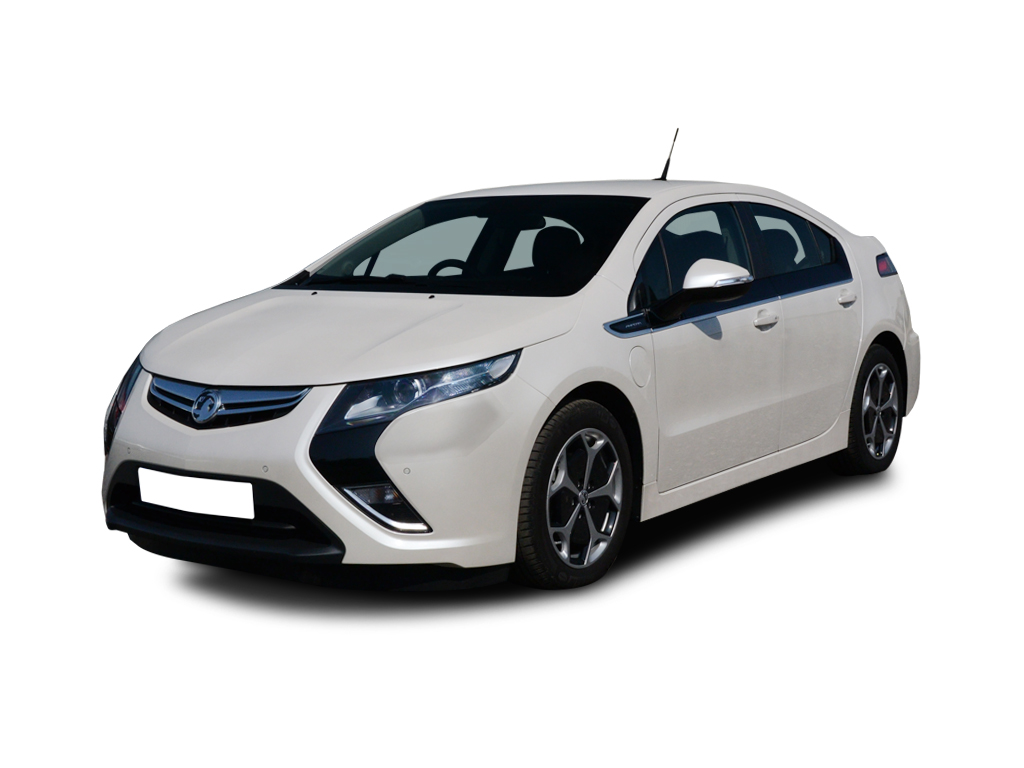
AmperaAfter seven years of Wizzing the time had come for a change. Back in 2007 there was little else available, but electric vehicles have come on a long way in that time. The most significant driver for a change was something larger that we could get the whole family in – the G-Wiz notionally has four seats but the rear ones are too small for adults or car seats effectively making the G-Wiz a 2+2. I considered various alternatives and eventually settled on a Vauxhall Ampera encouraged by a substantial discount.

The Ampera is a four seater hatchback with an electric range of up to 50 miles. It’s actually a plug-in hybrid, so it initially runs as a fully electric vehicle, but then when the battery is exhausted it runs as a petrol-electric hybrid. Most days (and indeed weeks) I use no petrol, but occasionally I can do long trips of a few hundred miles without stopping to charge. For most of the period of my ownership my lifetime average economy has been 250+ mpg, but that’s dropped to 190+ mpg following a few round trips to Cheshire.

Please follow and like Greening Me:
Pin Share

We have moved

Well, after nearly 20 years in the previous house the time came to move. What had started as “One man’s journey” became a couple’s journey and then a family’s journey and eventually the point was reached that enough was enough, or rather non-enough was not-enough when it came to space. A journey that started with my wife proposing a new conservatory (opposed by yours truly) ended up with a significantly larger house about a mile closer to the station. So far for the good news.

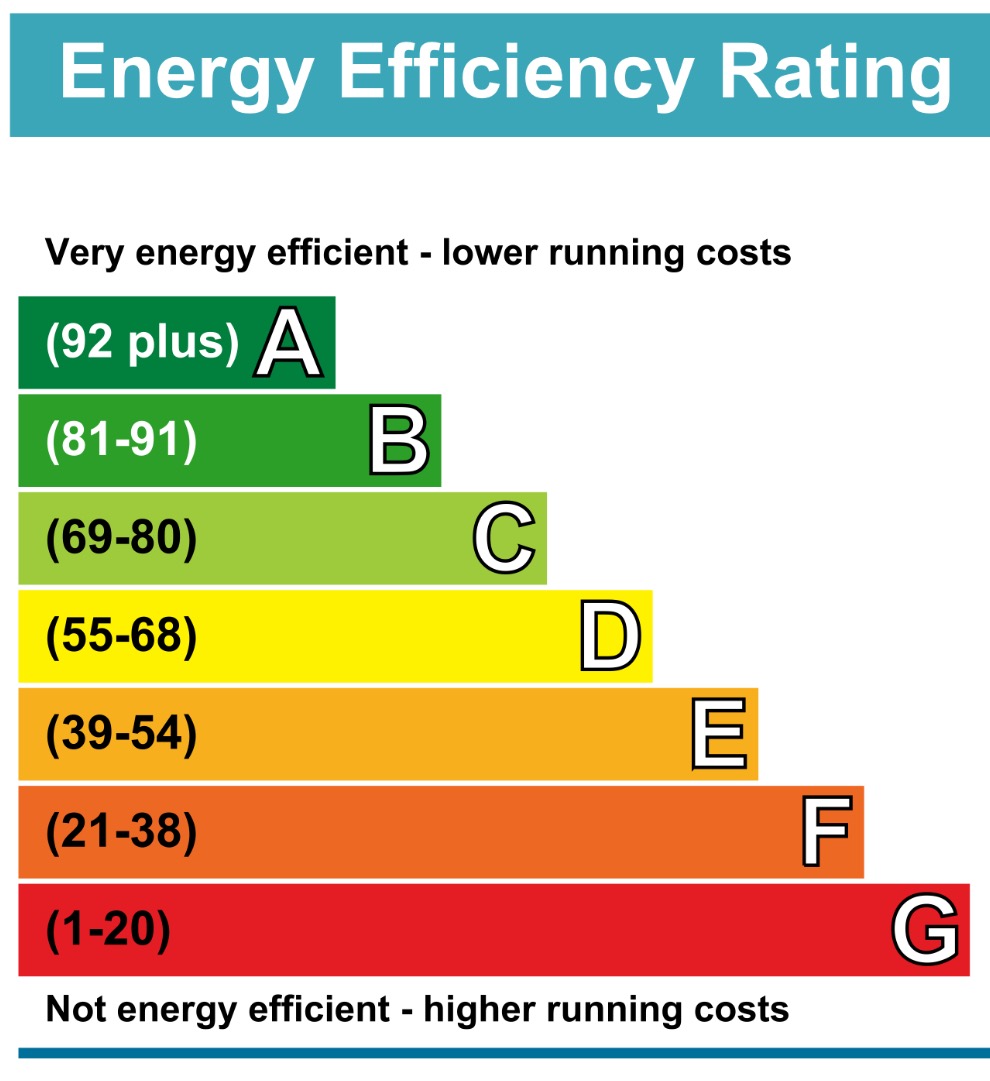
EPC scaleThe bad news is that our new-to-us 1970s detached house was rated E52 (on the UK’s scale of A100 to G1 for environmental performance) on the seller’s Environmental Performance Certificate. Fortunately it did have a full set of 2-year-old double glazing but not much else – including it turned out an arthritic boiler that couldn’t heat all the radiators but did manage to heat both expansion tanks in the loft.

So, over the last few months, we’ve been sorting out a few things to improve our environmental credentials and, at the same time, reduce the energy costs estimated at £2,114 per annum (£176 per month) on the EPC.

One of the first things we added was 4kW of solar panels on our south-south-east facing roof. That wouldn’t necessarily have been my first priority as autumn headed for winter, but with a reduction in the feed-in tariffs imminent it seemed sensible to act sooner rather than later. To get the highest feed-in tariff rate it turned out that I also needed a ‘D’ so I switched to low energy bulbs (worth 2 points), fitted the panels (worth 6 points), all of which should have got me 8 points so a D60 and then ordered a new survey..

The new survey came in as a C73 rather more than the D that I’d expected. Key highlights in the different surveys were:
o Walls – from 2 stars to 4 stars as the new survey found evidence of existing cavity wall fill,
o Windows – from 3 to 4 stars after I showed evidence of the installation date,
o Main heating controls – declined from 4 to 3 stars as only 2 TRVs found,
o Lighting – from 1 to 5 stars with all my new low energy bulbs.

Subsequently we sorted out the boiler and controls, so picking up the points values of the latest EPC:
o Hot water cylinder thermostat (as we went from gravity hot water to pumped) – 3 points
o Heating controls (TRVs) – 1 point
o Replace boiler with new condensing boiler – 7 points
o Solar water heating – 1 point

That latest list amounts to 12 points which should have got us from E52 to B85.

Please follow and like Greening Me:
Pin Share

End of 2012 Gas Analysis

Well like many UK homes our central heating and hot water is fuelled by natural gas. We also use natural gas for cooking on the stove top (the oven is however electric) and we have a gas fire in the living room, but these latter two uses are much less significant.
I’d lived here for 10 years before I started actively trying to reduce my energy consumption. During those 10 years I used an average of 562 units of gas annually.
Since then I’ve reduced my consumption by two routes, firstly to reduce heat loss so that less energy for heating was required, and secondly by replacing gas with renewable sources. It’s however also the case that my circumstances have not been constant during that time so, for example, when I started this I lived alone then 4 years or so ago I married and my wife joined me here; and now my wife is at home during the day with our baby daughter much of the time. Consequently the demand for hot water for washing and heating has increased.
The steps taken to reduce gas consumption include:

  • Having insulation installed in the cavities of the house walls. Houses here conventionally have a double skin of brick or block and, when this house was built, the cavity between the inner and outer layers was usually left as an air gap. We’ve had that gap filled with insulation as you would find in newer homes.
  • Increasing the thickness of insulation in the loft.
  • Replacing the old wooden windows with new PVC ones with higher “A” grade insulation – most easily seen by the larger air gap in the sealed units.
  • Installing solar water heating panels on the roof in conjunction with a larger hot water tank. In the summer these provide almost all our hot water (no heating is required), although at olther times of the heat they don’t provide enough heat alone for hot water they can help to pre-heat the cold water leaving the gas less work to do to achieve a usuable temperature.

We didn’t do this all at once, but if I compare the last 2 years to the original 10 year baseline then we’ve reduced average annual gas consumption by 23%. I think that the reduction would have been higher had our circumstances between constant.

Please follow and like Greening Me:
Pin Share

Wiz Wiz

One of the sources of CO2 emissions (major contributor to global warming) is fuel for transportation, which for most of us means petrol or Diesel. Various options exist for reduction including:

  • Buy a more fuel efficient model.
  • Buy something smaller.
  • Buy a Diesel rather than a petrol vehicle – but be cautious the CO2 saving is not as marked as the fuel economy benefit might suggest.
  • Use a renewable fuel such as E85 – but for me the nearest source is Ipswich which is many miles from my home in South Essex.
  • Buy a hybrid such as a Toyota Prius.

All of those can make a difference depending on what you currently drive, but I went further than that and have reduced my CO2 emissions from personal transportation by about 90%. Now I suppose that I could have used my bicycle more, but then a 7 mile trip to church or rehearsals would leave me hot and sweaty and it wouldn’t be practical to carry much music or my keyboard, so..

My electric vehicle

.. I went electric.

My G-Wiz is able to complete over 40 miles on a charge, and is responsible for no CO2 emissions since it is charged on renewable electricity. I reckon that I can do about 90% of my mileage in it. It’s not quick and it’s not pretty (in my opinion although some call it “cute”), but it is very green despite being black.

GoinGreen
G-Wiz Owner’s Club

Please follow and like Greening Me:
Pin Share

Well hello..

Hello out there.

This is for the moment something of an experiment as this is my first attempt at creating a blog, so polished it ain’t but hopefully it will get better over time.

Like many people I’m concerned about the state of our planet. It would seem that those of us in the west need to make some significant changes to our lifestyles to try and stop catastrophic damage to our world. Some reports talk of global warming wiping out whole countries and creating hundreds of millions of refugees. Something needs to be done. Someone needs to do something.

Then it occurred to me, here I sit in the UK in one of the world’s wealthiest countries. I have a well paid job, and a nice home. If I can’t change my lifestyle for the better, then who can be expected to?

So over the coming months I’m going to be logging some of the changes that I’ve made. Some are quite big, and others are quite small, but among them there will be something that everyone can do, because even the longest journey is made one step at a time.

Please follow and like Greening Me:
Pin Share

Electricity

One of the easiest things that can be done to reduce the environmental impact of your home is to use renewable energy. You could of course buy your own wind turbine or cover the roof with photovoltaics, but those are both quite expensive and may not be appropriate for all homes. However that doesn’t stop you using renewable energy.Wind Turbine at Dagenham

You might not be able to make your own, but why not buy it from someone else? Just as you can shop around to buy cheaper electricity you can also shop around for greener electricity. A service like Simply Switch can quickly find you a greener electricity supplier, and depending on who you buy your power from now it won’t necessarily be any more expensive.

Please follow and like Greening Me:
Pin Share